
Why your mulch keeps washing out, and what actually stops it
Mulch washing onto the lawn every time it rains is a containment problem, not a mulch problem. What actually works on Oahu, ranked by cost and lifespan.

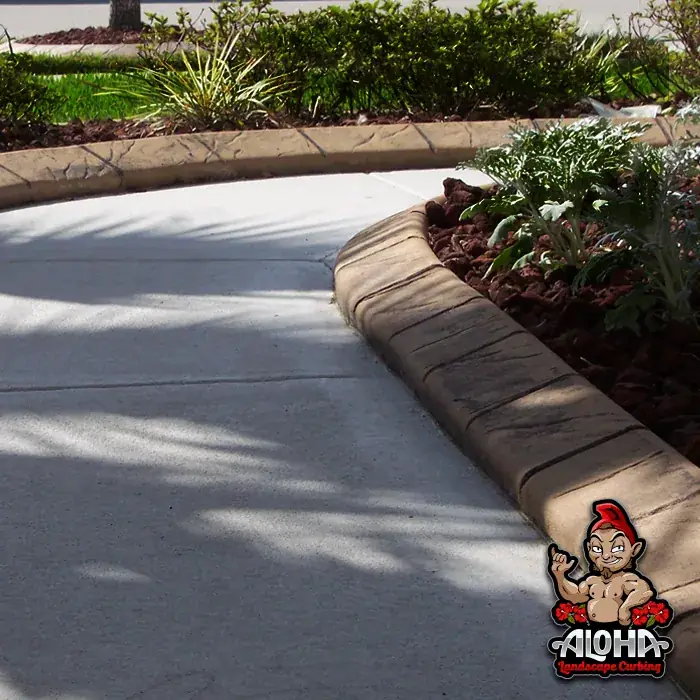
You top up the beds, it looks great for a month, then one good rain puts half of it on the lawn and in the driveway. You rake it back. Six weeks later, again.
This is not a mulch problem. You are not buying the wrong mulch or spreading it wrong. It is a containment problem, and it has a small number of real solutions.
What is actually happening
Mulch floats. Bark, wood chips, and shredded hardwood are all less dense than water, so once a bed is saturated and water is moving across the surface, the mulch moves with it. It does not need much slope. A quarter inch of fall across a bed is plenty.
Two things make this dramatically worse on Oahu than in most places.
The rain arrives all at once. Kaneohe averages around 65 inches a year and the upper Koolau slopes take considerably more, but the annual number is misleading. What matters is intensity. An inch falling over eight hours soaks in. An inch falling in forty minutes runs off, and everything loose goes with it.
The ground underneath does not drain. Much of windward Oahu sits on highly weathered red clay with slow permeability. Once it is saturated, it stops accepting water entirely and everything that lands becomes surface flow.
So you have a floating material sitting on ground that turns into a shallow river a few times a year. Of course it leaves.
What does not work
Digging a deeper bed. A sunken bed holds water rather than shedding it, which drowns roots and makes the mulch soggy and matted. On clay this is actively harmful.
Heavier mulch. Larger bark nuggets move a bit less than shredded, but they still move, and they are worse at moisture retention and weed suppression, which were the reasons for mulching in the first place.
Plastic edging. This is the one everybody tries. It is cheap, it is at every hardware store, and it lasts three to five years here. In Hawaii UV it goes brittle faster than the packaging claims. The stakes work loose, the sections separate at the joints, and it starts rising up out of the ground. That is a problem in itself. A two-inch lip is not enough to hold back a moving sheet of water, and a curled-up section of edging holds back nothing at all.
Landscape fabric under the mulch. Fabric stops weeds coming up from below. It does nothing about mulch leaving from above. If anything it makes runoff slightly worse, because water cannot soak through it as readily.
What does work
Ranked by how long it lasts, which is the number that actually matters:
Rock instead of mulch
Cost: moderate. Lifespan: effectively permanent.
Decorative rock does not float. Problem solved at the source. The trade-offs are real: rock does not feed the soil as it breaks down, it holds heat against plants, it is miserable to weed once organic matter accumulates in the gaps, and it is genuinely difficult to remove if you change your mind. It also still needs an edge, because loose stone spreading into turf is a hazard the first time a mower finds it.
Good for low-water and xeriscape beds. Poor around anything that wants rich soil.
A physical border with height
Cost: varies enormously. Lifespan: three years to twenty-plus.
This is the real answer for most people. You need a vertical face standing proud of the mulch line, high enough that surface water hits it and stops rather than flowing over. Two to four inches of exposed height is the useful range.
Everything comes down to what that border is made of and how long it stays where you put it:
| Border | Lifespan | What ends it |
|---|---|---|
| Plastic / poly | 3–5 yrs | UV embrittlement, stakes lift, joints separate |
| Metal / steel | 5–10 yrs | Rust, and faster near the ocean |
| Paver or brick | 10–15 yrs | Individual units shift, gaps open between them |
| Pressure-treated wood | shortest here | Rots in this humidity; wood in soil contact is what subterranean termites are looking for |
| Poured concrete curbing | 20+ yrs | Ground movement, roots, vehicle impact |
The gap between three years and twenty years is the whole decision. Plastic edging is not a cheaper version of concrete curbing; it is a temporary version, and you buy it five to eight times over the life of one concrete curb.
Note the specific weakness of pavers and brick for this job: the joints between individual units are exactly the path both water and grass exploit. A continuous border has no joints.
Fix the water, not just the mulch
Sometimes the bed is not the problem. If runoff from a roof, a driveway, or a neighboring slope is crossing your bed, no border is going to hold against it indefinitely. You are asking a four-inch curb to act as a dam.
Signs it is a drainage problem rather than a containment problem: the mulch leaves from one specific spot every time rather than generally; there is visible scouring or a channel in the bed; the same area stays wet for days after rain.
That wants a drainage fix, and a border after.
The Hawaii detail nobody mentions
If you do put in a solid continuous border along a foundation on windward-side clay, it has to have gaps in it.
This is the mistake we most often get called to fix. An unbroken curb along the side of a house on ground that drains slowly is a retaining wall for water. It does its containment job perfectly and holds several inches of standing water against your foundation during a heavy storm.
The fix is simple and has to happen at install: half-inch gaps cast into the run at the low points, spaced roughly fifteen to twenty feet apart. Water passes through. Mulch and rock do not. The gap is narrow enough to pass water while still holding back solids. It is a small detail that a crew trained in a dry climate has no reason to think about, and on this island it is most of the job.
One more thing worth knowing
Coconut rhinoceros beetle larvae develop in mulch, compost, and green waste piles, and CRB is widespread on Oahu. This is a genuine argument for a contained bed rather than a sprawling one: mulch at a controlled depth in a defined area is mulch you can actually inspect and turn over, instead of a deep undisturbed pile that sits for years.
Check bagged mulch for beetle entry and exit holes before you buy it, do not move host material around the island, and report sightings to 643-PEST. That is management rather than control, but it is worth doing.
The honest summary
If you are going to be in the house another two or three years, plastic edging is fine and we would not talk you out of it. If your beds move around a lot because you are still figuring out the garden, do not put in anything permanent yet.
If the beds are settled and you plan to stay, the math favors doing it once. And if the run goes along your house on the windward side, whoever you hire, make sure they are putting drainage gaps in it.
Questions about a specific yard? Call or text 808-452-1022, or see what curbing costs on Oahu.