
Concrete curbing vs plastic edging: the twenty-five year math
Plastic edging costs a fraction of concrete curbing upfront. Run both over twenty-five years, including replacements, and the answer is less obvious than it looks.

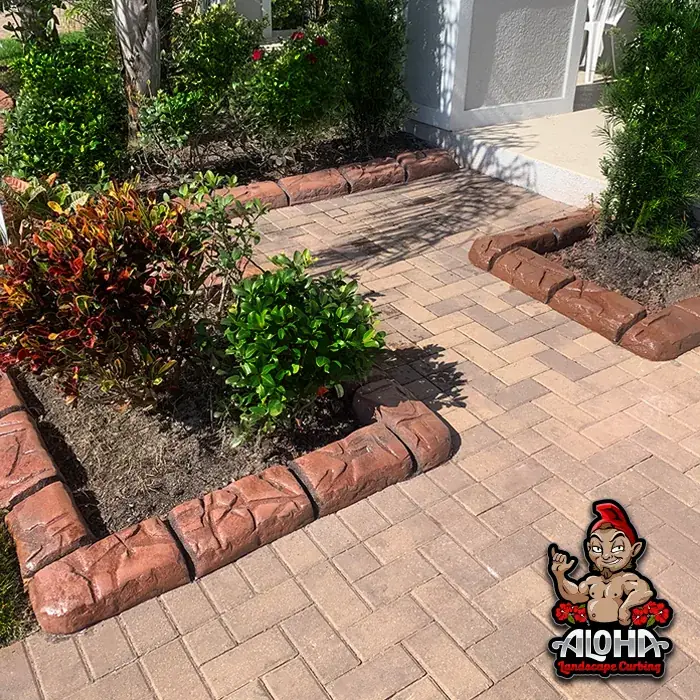
Plastic edging costs about fifty cents to three dollars a foot. Concrete curbing on Oahu runs forty to sixty-eight. That is a factor of twenty at the point of sale, and any comparison that skips over it is not being straight with you.
So let us do the whole calculation properly, including the parts that flatter concrete and the parts that do not.
The upfront number
For 100 linear feet of border:
| Materials | Installed | |
|---|---|---|
| Plastic / poly edging | $50 – $325 | usually DIY |
| Metal / steel edging | $170 – $470 | usually DIY |
| Paver or brick border | $200 – $400 | DIY or contractor |
| Concrete curbing (Oahu) | n/a | $4,000 – $5,000 |
Concrete is not close. It is a different category of purchase.
The twenty-five year number
Now run it forward. Plastic edging lasts three to five years, and less than that in Hawaii UV, which is harsher than most of the mainland. Call it four. Over twenty-five years that is five to eight replacements.
| 25-year material cost | Times you do the work | |
|---|---|---|
| Plastic / poly | $300 – $2,600 | 5 – 8 |
| Metal / steel | $510 – $1,880 | 2 – 4 |
| Paver or brick | $400 – $1,200 | 1 – 2, plus resetting shifted units |
| Concrete curbing | $4,000 – $5,000 | 0, plus resealing |
And here is the part most curbing companies quietly leave out: on pure materials, plastic still wins. Even at eight replacements, you are looking at $2,600 against $4,000 to $5,000.
Anyone who tells you concrete curbing pays for itself in materials is doing arithmetic that does not survive contact with a calculator. It does not. It is a more expensive way to border a bed, full stop.
So what are you actually buying
Three things, and they are worth being precise about because they are the entire case.
1. Your weekends, five to eight times over
Every replacement is a day. Pull the old sections, dig the trench again, set the new run, stake it, backfill, tidy up. Between replacements there is ongoing maintenance. Pushing sections back down after they lift. Re-staking after a mower catches a corner. Straightening the run where it has bowed.
Nobody prices their own Saturday, which is exactly why the material-only comparison is misleading.
2. How it looks for most of those twenty-five years
Plastic edging looks acceptable for its first year. Then it starts showing. UV chalks the surface, the black goes gray, the joints separate slightly, and sections rise up out of the ground where the stakes have worked loose. By year three it looks like what it is.
You do not get four years of good-looking edging followed by a clean replacement. You get one good year, two mediocre ones, and a bad one, on repeat.
3. Continuity
This is the technical difference and it is the one that matters most functionally.
Plastic edging comes in sections that butt together. Pavers are individual units. Both have joints along their entire length, and joints are exactly where grass finds a way through and where water finds a path. A stolon does not have to climb over a border if it can go between two pieces of it.
Extruded concrete curbing is one continuous piece for the whole run. No sections, no joints, nothing to separate. That is a functional advantage, not an aesthetic one.
Where plastic edging is genuinely the right answer
We install concrete curbing for a living and we will still tell you to buy plastic in these situations:
- You are moving within a few years. Concrete curbing is a permanent modification. It will not return its cost at sale and you will not be there to enjoy the other twenty-two years.
- Your beds are not settled. If you are still working out the garden and bed shapes change season to season, do not pour anything. Curbing is for a design you have decided on.
- It is a small, low-visibility run. Thirty feet along a back fence nobody looks at does not justify mobilizing a machine and a mixer. Our own short-run rate on a job that size is $60 to $75 a foot, and we will say plainly that it is poor value.
- The budget genuinely is not there. Plastic edging that exists beats concrete curbing you cannot afford. That is not a consolation prize, it is the correct decision.
Where concrete wins clearly
- Settled beds in a house you are staying in. The permanence stops being a drawback and starts being the point.
- Long continuous runs. Per-foot cost drops with length, and continuity delivers most of its value across a long span.
- Anywhere a mower runs along the edge. A mow strip profile lets the wheel ride on the concrete, which ends string trimming on that line permanently. No plastic edging can do this, because a mower wheel on plastic edging destroys the plastic edging.
- Holding back rock. Loose decorative stone against plastic edging pushes it out of line within a season.
- Slopes and anywhere water moves. A four-inch concrete face with drainage gaps cast into it manages runoff. Plastic gets undermined and floats.
- When you want it to look deliberate. Integral color and a stamped pattern is a design element. Plastic edging is, at best, invisible.
The Hawaii adjustments
Three local factors shift this comparison from where it sits on the mainland, two of them against plastic:
UV is harder here. Plastic edging’s three-to-five-year lifespan is a national average. Under this sun, expect the shorter end.
Steel rusts faster near the ocean. Metal edging is a reasonable middle option in Denver. Within reach of salt spray on Oahu it is on a shorter clock than the five-to-ten-year figure suggests.
Wood is off the table. Pressure-treated timber edging rots quickly in this humidity, and wood in soil contact is precisely what Formosan subterranean termites forage for. It is cheap and it is a bad idea here.
The one factor that runs the other way: concrete costs more in Hawaii than anywhere else in the United States. Ready-mix runs roughly 1.35 times the national average and construction costs sit 20 to 40 percent above the mainland, because almost everything arrives by barge. So the upfront gap between plastic and concrete is wider here than it would be in Ohio.
The one-line version
Plastic edging is cheaper over twenty-five years and always will be. You are paying the difference to do the job once, to have it look right the whole time, and to never think about it again. Whether that is worth four thousand dollars depends entirely on how long you are staying and how much your Saturdays are worth to you.
See what curbing would cost on your yard, or read the full Oahu rate card.