
CurbColor
Pigment goes into the mix, not onto the surface. The color runs through the entire curb, so a scuff from a mower or a chip from a dropped tool shows the same color underneath instead of bare gray. That is the whole difference between integral color and a stain, and it is why we do not offer the stain.
$48 – $62 per linear foot installed, 100 ft or more
That is the $40 to $50 standard rate plus $8 to $12 a foot for the pigment. Under 100 ft the rate steps up to $60 to $75 a foot before color.
The range
Swatches below are approximations for orientation only. A screen physically cannot render a concrete color, and concrete shifts as it cures and again once sealer goes on. Ask Shaden for the physical chip card before you commit. It is free and it takes one visit.
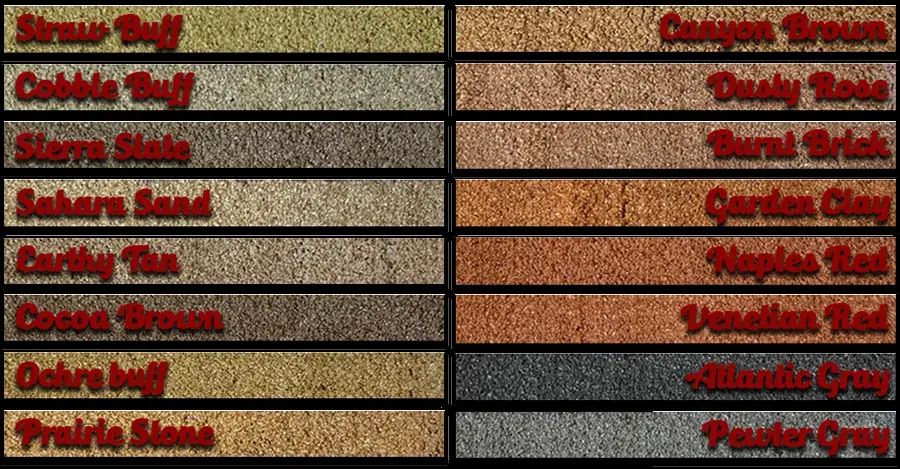
Picking a color that still looks right in five years
The instinct is to match the house. The better move is usually to pick up something already in the hardscape: the rock wall, the pavers, the roof, the lava rock in the bed. A curb that echoes a material already on the property reads as though it was always there. A curb matched to the paint reads as new the moment the house gets repainted.
Second thing: go one step quieter than feels right on the sample. A chip in your hand is two square inches. On 150 feet of border in full Hawaii sun, that same color is a lot more color. Earthy Tan, Cobble Buff, and Pewter Gray are what most people land on for exactly this reason, and none of them ever look like a mistake.
Does it fade?
The pigment does not. Integral colors are formulated to hold up under UV, and the proof is easy to see on any partly shaded slab, where the shaded half and the sunny half still match years later. What breaks down is the sealer sitting on top of it.
Test it with a hose. Water beads, the sealer is fine. Water soaks straight in, it is time to recoat. Under this sun an acrylic wants refreshing every one to two years. Near the ocean we switch to a penetrating silane-siloxane that runs seven to ten years, though it gives up some of the wet-look depth that makes color pop.
Antiquing: the second color
Integral color on its own gives you one flat tone. Antiquing powder is a second color broadcast over the surface before stamping, so it settles into the texture and stays in the low points. That is what produces the variegated, aged-stone look rather than a single uniform band.
It only works on a stamped or textured finish. There is nowhere for the powder to sit on a smooth curb. If you want depth and variation, you are really looking at stamped edging or the stone finish rather than color alone.
Color on standard curbing
You do not need a pattern to get color. Plain profile plus integral color is the most common thing we install: it is a clean, solid, single-tone border that reads as intentional and costs meaningfully less than stamped. If the goal is a tidy line rather than a feature, this is the one.
See your number before you call anyone
The calculator runs on the same rates we quote from. No form, no email gate, no waiting for a callback to find out whether this is even in your budget.
Lock in your price
Name, phone and town is all it takes. Shaden walks the yard, confirms the number in writing, and there is no charge and no obligation either way.
- Reply within 24 hours, usually the same day.
- Owners on the phone, Shaden on site. No call center, no sales rep, no lead broker.
- Written price before any work. The number on site is the number you pay.