
How to keep grass out of your flower beds in Hawaii
Whether a border stops grass invading your beds depends entirely on which grass you have. St. Augustine and paspalum, yes. Bermuda, not completely.

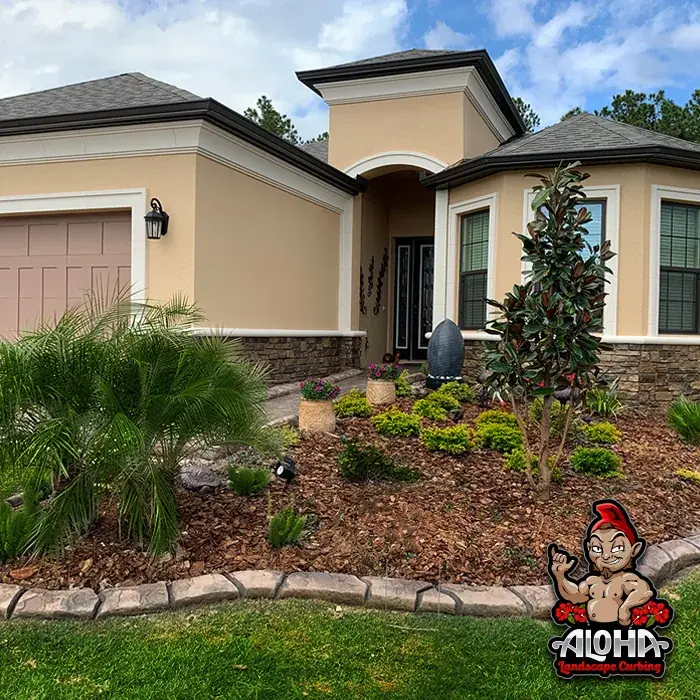
You edge the bed. Six weeks later the grass is back over the line. You edge it again.
On the mainland this is a seasonal annoyance. In Hawaii there is no winter dormancy, so warm-season turf grows and spreads all year. The invasion pressure never stops, which is why an edge that holds by itself is worth more here than almost anywhere.
Whether a border actually solves it depends on one thing most articles skip entirely: which grass you have.
The distinction that decides everything
Turfgrasses spread two ways, and the difference is the whole answer.
Stolons are runners that travel across the surface of the ground. You can see them. They root down at intervals as they go.
Rhizomes are stems that travel underground, typically a few inches down. You cannot see them, and they surface some distance from where they started.
A raised border is a physical obstacle. It works well against something crawling over the surface and poorly against something tunnelling beneath it.
| Grass | Spreads by | Stopped by a standard curb? |
|---|---|---|
| St. Augustine | Stolons only | Yes |
| Seashore paspalum | Stolons only | Yes |
| Centipede | Stolons only | Yes |
| Zoysia | Stolons + rhizomes | Mostly. It spreads slowly enough that a border holds in practice |
| Bermuda | Stolons and rhizomes | Not completely |
The good news
If you have St. Augustine, and a great deal of Oahu does because it is the most shade-tolerant warm-season grass we can grow, a border genuinely fixes this.
St. Augustine spreads by stolons only. To get into your bed, a runner has to climb a vertical face and then root into loose, dry mulch on the other side. It is bad at both. A curb standing three to four inches proud of the bed line is a real barrier, not a speed bump, and the creep essentially stops.
Same for seashore paspalum, which is common near the water because it takes salt better than anything else.
The honest bad news
Bermuda grass is different, and we will not pretend otherwise.
Bermuda spreads by stolons above ground and rhizomes below, with deeper roots than most lawn grasses. Guidance for containing Bermuda specifically calls for a barrier at least eight inches deep, going underground to block rhizomes as well as standing above grade to stop surface runners.
Extruded concrete curbing sits four to six inches proud with a shallow footing lip. It is not eight inches of subsurface barrier and it does not pretend to be. Bermuda rhizomes will eventually find their way under it.
What curbing does do for a Bermuda lawn:
- Ends string trimming along that line permanently, especially with a mow strip profile
- Gives you a clean, defined edge that stays where it is
- Cuts surface-runner invasion, which is the majority of the visible creep
- Makes what does come through obvious and easy to pull, because it emerges in a defined line
What it does not do is end the problem. You will still be managing that bed edge once or twice a year.
We would rather say this before you spend four thousand dollars than have you find out in year two.
Not sure which grass you have?
Quick field identification:
St. Augustine. Wide, flat, coarse blades with a blunt rounded tip. Thick spongy runners you can see lying on the surface, easy to pull up like a rope. Grows well in shade.
Bermuda. Fine, narrow blades. Grows dense and low. Seed heads look like three to five thin fingers spreading from one point. Hates shade. Dig a few inches down at the bed edge: if you find white underground stems running horizontally, that is rhizomes, and that is Bermuda.
Zoysia. Fine to medium blades, very dense, stiff and slightly prickly underfoot. Slow to spread and slow to recover.
Seashore paspalum. Medium blade, deep green, common close to the ocean and on salty irrigation.
What actually works, by effort
Hand edging. Free, works on everything, and you do it forever. Every four to six weeks in Hawaii, all year.
Trenched edge (a spade-cut V-trench between lawn and bed). Free, genuinely effective against stolons because a runner has to cross an air gap, but it collapses and needs recutting a few times a year. Best short-term option and no money down.
Plastic edging. Cheap, and three to five years in this sun. It also fails at exactly the wrong job: sections separate at the joints, and a joint is a doorway. Grass goes through the gap rather than over the top.
Metal edging. Thin profile and genuinely deep, so it is actually the better barrier against rhizomes than concrete curbing is. The catch is that it rusts, faster near salt, and there is not much above grade to hold mulch back.
Concrete curbing. Continuous with no joints, twenty-plus years, holds mulch as well as blocking grass, and a mow strip profile ends trimming. Complete answer for stolon grasses. Partial answer for Bermuda.
Herbicide along the edge. Works, needs repeating, and drift into your ornamentals is a genuine risk. Follow the label. If you go this route, read it properly rather than eyeballing the dilution.
The realistic recommendation
St. Augustine, paspalum, or centipede, settled beds, staying in the house: a continuous border solves this permanently. That is what it is for.
Bermuda: a border is a large improvement and not a cure. Consider whether the trimming and the tidy line are worth it on their own, because that is what you are actually buying. If total exclusion is the goal, you want a deep subsurface barrier, which is a different product.
Beds still changing shape: do not install anything permanent. Cut a trench edge and revisit in a year.
Renting, or moving soon: trench edge or plastic. Do not pour concrete on someone else’s investment.
Want a straight answer about your own yard? Call or text 808-452-1022, including if the answer is that you do not need us.