
Concrete curbing vs rock borders, which most Oahu yards actually need
On the mainland curbing competes with plastic edging. On Oahu it competes with lava rock and blue rock, and the honest answer is that most yards want both.

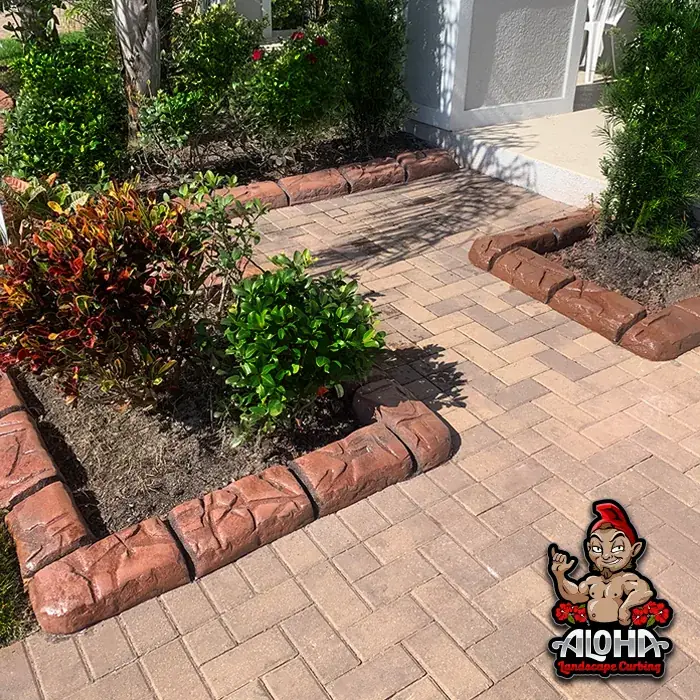
Every article comparing concrete curbing to something else compares it to plastic edging. That is a mainland conversation. Walk any street in Mililani or Hawaii Kai and the border you actually see is rock.
So here is the comparison nobody has written, and the short answer up front: rock and curbing are not competitors. On most Oahu yards the curb is what keeps the rock where you put it.
Why rock is the default here in the first place
There are good reasons it became the standard, and they are not just aesthetic.
Rock does not rot, which matters in a climate where pressure-treated timber edging fails in a few years. It does not go brittle in UV the way plastic does at this latitude. It drains, which matters enormously on the windward side. And it looks like it belongs, because on a volcanic island it literally does.
Then there is availability. Cinder and lava rock are local material. Almost every other landscape product on this island arrives on a barge, and you pay for the barge.
Where rock borders quietly fail
Four things go wrong, and they go wrong slowly enough that people blame themselves rather than the material.
The stones migrate
A rock border is a pile of loose objects arranged in a line. Nothing holds it in that line. Every heavy rain moves it a little, every time somebody walks the edge it moves a little, and after two or three years the crisp line you laid has spread eighteen inches into the lawn on one side and into the bed on the other.
You can rake it back. You will rake it back again.
The gaps are where the grass gets in
This is the same structural problem paver and brick borders have, and it is worth understanding because it is the whole argument.
A raised concrete curb is one continuous piece. To get into your bed, a stolon has to climb a vertical face and root into dry mulch on the far side, and St. Augustine is bad at both. A rock border has a gap every few inches. The grass does not climb anything. It goes between.
Worse, organic matter accumulates in those gaps. Leaf litter, dust, the fine red dirt that gets everywhere in central Oahu. Within a couple of years you have a strip of thin soil running the length of your border, and that is a seedbed.
A mower turns it into a projectile
Loose stone at a lawn edge and a rotary mower are a genuinely bad combination. It is the reason most landscapers hate rock borders on a maintained lawn, and it is a safety issue rather than an aesthetic one.
It still needs an edge
This is the part people discover after they have already bought the rock. To keep a rock bed looking like a rock bed rather than a slowly spreading gravel patch, something has to contain it. Which is where most people end up buying plastic edging to hold in the rock they bought to replace the edging.
What it costs, honestly
We are not going to publish a per ton price for rock, because we do not sell rock and we are not going to guess at somebody else’s current number. Call Hawaiian Earth Products or Island Topsoil and ask. They will tell you in about a minute.
What we can tell you is the shape of the comparison:
| Rock border | Concrete curbing | |
|---|---|---|
| Material cost | Low to moderate, and local | Higher, and Hawaii concrete runs about 1.35x the national average |
| Install | DIY possible, heavy work | One day, machine and crew |
| Lifespan of the material | Effectively forever | 20+ years |
| Lifespan of the line | 2 to 3 years before it needs resetting | The life of the curb |
| Grass through it | Yes, through the gaps | No, for stolon grasses |
| Contains mulch or rock | No, it is the thing needing containing | Yes, that is the job |
| Mower safety | Poor at a lawn edge | Mow strip profile lets the wheel ride on it |
The row that matters is the difference between the two lifespans. The rock lasts forever. The arrangement of the rock does not.
The answer most yards actually need
Put the curb in, then fill the bed with rock.
The curb gives you the line that stays a line, keeps stone out of the turf, ends the trimming, and gives the mower something safe to run against. The rock gives you the surface you wanted, with no annual mulch top up and nothing for weeds to root into.
That is not us selling you both. It is the arrangement almost every rock bed on this island eventually converges on anyway, usually after somebody has already bought plastic edging twice.
When rock alone is genuinely fine
We would rather tell you this than have you spend money you did not need to.
- A bed that touches no lawn. Against a wall, a fence, a driveway, or a house. Nothing to migrate into and nothing to trim.
- Large informal areas. A xeriscape section or a slope where you actively want a loose natural edge rather than a hard line.
- Rock over 4 to 6 inches. Big stone does not migrate much. It is small decorative rock, three quarter inch and under, that spreads.
- You are not staying. Same rule as everywhere else on this site.
One thing to know before you order rock
Lay the border first, fill second. It is a small sequencing point that costs real money to get wrong.
If the rock goes in first, the curb still has to go in, which means about a foot of your new rock gets excavated and mixed with soil along the whole run. It cannot be cleanly recovered. Same rule applies to sod.
Trying to work out what your yard needs? Call or text 808-452-1022, including if the answer is rock and no curb. Or price a run here.