
Mulch against your foundation, and the termite problem nobody mentions
Mulch does not attract termites from across the neighborhood. What it does is build the exact conditions they need, right where your house meets the ground.

Short answer: mulch does not pull termites to your property from somewhere else. What a deep mulch bed pushed up against your foundation does is create the three conditions subterranean termites need, in the one place you least want them.
That is worth knowing on this island in particular, because of what lives in the soil here.
What is actually in the ground on Oahu
The Formosan subterranean termite is established across Hawaii and it is not a minor pest. It has threatened Iolani Palace. A mature colony can consume around 13 ounces of wood a day, roughly 400 grams, which is an order of magnitude beyond what most people picture when they think termite damage.
Most local people call them ground termites, which is a better name than the technical one because it describes the important thing. They live in the soil and forage through it to reach wood. They are not flying in. They are already under the yard.
The three conditions, and why mulch supplies all of them
Pest control guidance is consistent on this and the reasoning is worth understanding rather than just following.
Moisture. Mulch traps water against the soil and holds humidity up. Subterranean termites need moisture and will not cross a dry, exposed strip readily.
Food. Wood based mulch is cellulose, which is what they eat. Bark, chips, shredded hardwood. All of it is on the menu.
Cover. This is the one people miss. Termites avoid open air. A continuous mulch bed running up to your wall is a covered corridor from soil to structure, and they will use it.
None of that means mulch is bad. It means depth and distance matter, and most beds on Oahu get both wrong.
The numbers
Standard guidance, and it is easy to check against any pest control source:
- Keep a gap of about 12 inches of bare soil or very thin mulch between the foundation and any mulch bed
- Never deeper than 3 inches anywhere in the bed, and thinner still in that first foot
- At least 6 inches of clearance below any wood siding or framing
Now go and look at your beds. On most Oahu properties the mulch runs straight up to the wall, and it is deep, because deep mulch suppresses weeds and everybody wants fewer weeds.
Where a border comes into this
Being straight with you: a concrete curb is not termite control and we are not going to pretend it is. If you have an active infestation you need a licensed pest control operator, not a landscaper.
What a hard border does is make the conditions above controllable, and right now most people have no way to control them at all.
An unbordered mulch bed has no defined edge, so it has no defined depth and no defined distance from the wall. It creeps outward as you top it up, and it creeps deeper each time. Nobody measures it. Nobody could.
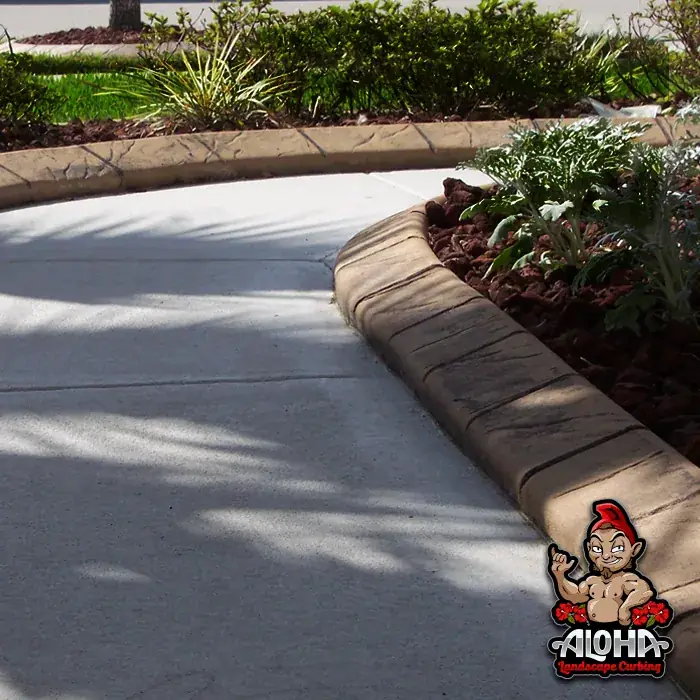
A curb set back from the foundation gives you a bed with an actual edge. The mulch goes to a set depth because there is a physical line telling you where the top is. It stays a set distance from the wall because it cannot migrate. And the strip between curb and foundation stays open, dry and visible, which is exactly the inspection gap the guidance is describing.
That is a real benefit and it is a modest one. It belongs in the honest column, not the headline.
The other thing living in your mulch
While we are on it. Coconut rhinoceros beetle is widespread on Oahu, and CRB larvae develop in mulch, compost, green waste and palm debris. Beetles and larvae live in dirt and mulch, not in trees.
The practical guidance is to inspect mulch piles, avoid moving host material around, and check bagged mulch for the entry and exit holes that indicate a breeding population before you buy it. Report sightings to 643-PEST. For disposal, use City and County green waste, Hawaiian Earth Products, or Island Topsoil.
Same argument as the termites and the same limits. A contained bed holding a controlled depth of mulch is one you can actually turn over and look at. A sprawling one that has been quietly deepening for four years is not.
To be clear about what this is not: there is no formal statewide quarantine on moving mulch. The 2025 action was a voluntary stop movement order for West Hawaii on Hawaii Island, and a formal rule was still in development last we checked. Anyone telling you it is illegal to move mulch on Oahu is overstating it.
What to actually do this month
None of this requires hiring anybody.
- Walk your foundation. Look for mulch touching the wall or covering the bottom of wood siding.
- Pull mulch back to leave roughly a foot of bare soil at the wall.
- Rake the rest down to three inches or less. You will have more mulch than you expected.
- Check any timber edging in soil contact. Wood in the ground next to a house is exactly what you are trying to avoid, and it is worth removing regardless of what you replace it with.
- If you find mud tubes on the foundation, stop and call a licensed pest control operator.
Steps one through four are free and take an afternoon. If afterwards you want a border that holds the depth and distance for you rather than doing it again every year, that is the conversation we are useful for.
Questions about your own yard? Call or text 808-452-1022. If the answer is a pest control operator rather than a curb, we will say so.